© Agency for Cultural Affairs.
HAYAKAWA Megumi
Starting around 1950, a series of Walt Disney color animated films from the previous two decades—including numerous previously unreleased titles, starting with Snow White and the Seven Dwarfs (1937)—were released one after another in Japan. With only a limited number of domestically produced animated works, the discourse of critics at the time simultaneously expressed strong admiration for foreign animation, particularly Disney, while casting a critical eye on Japanese animation, accompanied by expectations for its future. It is also evident that the presence of Walt Disney exerted a clear influence on the works by TOEI DOGA, YOKOYAMA Ryuichi’s Otogi Production, and TEZUKA Osamu’s Mushi Production, created in this adverse climate. Drawing primarily on discourse analysis, this article explores the development of the Japanese animation industry from the mid-1950s to the early 1960s through the lens of its confrontation with Walt Disney.
Founded in 1923 as a small cartoon studio by the DISNEY brothers, the company has, over the past century, evolved into a vast conglomerate known as The Walt Disney Company, whose animated works continue to enchant audiences across the globe to this day. Meanwhile, Japanese anime, starting with Tetsuwan atomu (Astro Boy) (1963), has established its own distinct position and earned high acclaim, becoming widely recognized as “anime” since the 1990s. A historical retrospective reveals that the relationship between Disney and the Japanese animation industry began even before the concept of anime emerged.
The renowned film scholar Paul WELLS writes the following about Disney’s presence in the history of American animated film: “[…] it might properly be argued that all cartoon animation that follows the Disney output is a reaction to Disney, aesthetically, technically and ideologically, in the sense that American animation is effectively a history of responses to Disney’s usurpation of the form in the period between 1933 and 1941.”1 This perspective proposes a bold approach to understanding the broader trajectory of animation film history through the lens of Disney’s influence, encompassing not only emulation but also reactions of rejection and resistance. The years 1933 to 1941 specified by WELLS mark the period in which Disney established its so-called “illusion of life” style, both technically and artistically, from the introduction of color and the production of its first feature-length film to the studio strike and, in broader political terms, the entry of the United States into World War II. In short, it demonstrates the magnitude of the influence exerted by the realistic full-animation style mastered by Disney, extending not only to its contemporaries but also having an indirect impact beyond its own time.2
Adopting WELLS’s perspective, this article seeks to interpret the developments of Japanese animation just prior to 1960, often regarded as a turning point in its history, as a response to Disney.3 More specifically, this study focuses on the two studios that spearheaded animation production during this period, and on the media discourse found in film magazines and newspapers that surrounded them. In this context, “Disney” refers to the Disney studio, symbolically represented by Walt DISNEY, and to its productions.
Following the release of Namakura gatana (The Dull Sword) (1917), regarded as Japan’s first animated film,4 numerous works demonstrating high technical and artistic achievement were produced. However, as production remained largely in the hands of individual artisan filmmakers and small-scale studios, the industry’s modernization failed to take hold. Because most works were used in educational contexts rather than in cinemas, profitability remained low, and large-scale investment in animation production also failed to develop. Consequently, a cottage-industry model of production took shape in the 1930s. During World War II, feature-length animations with pronounced propagandistic characteristics were produced in black and white. While government film policies did facilitate technical advancement, they did not generate substantial transformations in the industry’s structure itself. After the war, initiatives to consolidate animation artists and small-to-medium-sized studios were pursued, but ultimately proved unsuccessful. As a result, until the 1950s, animation production remained largely confined to short educational and promotional films, leaving production on a small scale and the market limited. The introduction of color film also failed to gain traction.
As the domestic animation industry struggled with stagnation, an additional blow came when screenings of foreign animated films resumed in the late 1940s, and Disney productions began to be shown in earnest.5 Snow White and the Seven Dwarfs (1937) finally reached theaters in 1950, 13 years after its original release, and Bambi (1942) followed in 1951, nine years late. This resulted in Japanese audiences seeing not only new works of the time but also Disney short and feature-length films produced over the past 20 years. Given that audiences had hardly any opportunities to view domestically produced animated works other than short films on the large screens of movie theaters, it is easy to imagine that this intensive encounter with commercially produced color animation, whether short or feature-length, came as a major shock to audiences. Although Disney films were already highly valued among critics in the 1930s and 1940s for their superior techniques and high level of artistry, it was in the 1950s—when the release of their feature-length films began—that Disney’s popularity and public recognition became unshakable. Even as the popularity and demand for theatrical animated films surged, evaluations of the condition of domestic animation were decidedly harsh.6
It was under these circumstances that, in the mid-1950s, two studios of completely different sizes and structures, TOEI DOGA and Otogi Production, were founded. In 1954, the newly established film company TOEI set up an educational film division and, responding to rising demand for educational content and television commercials, embarked on the production of animated films.
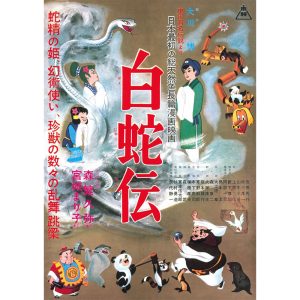
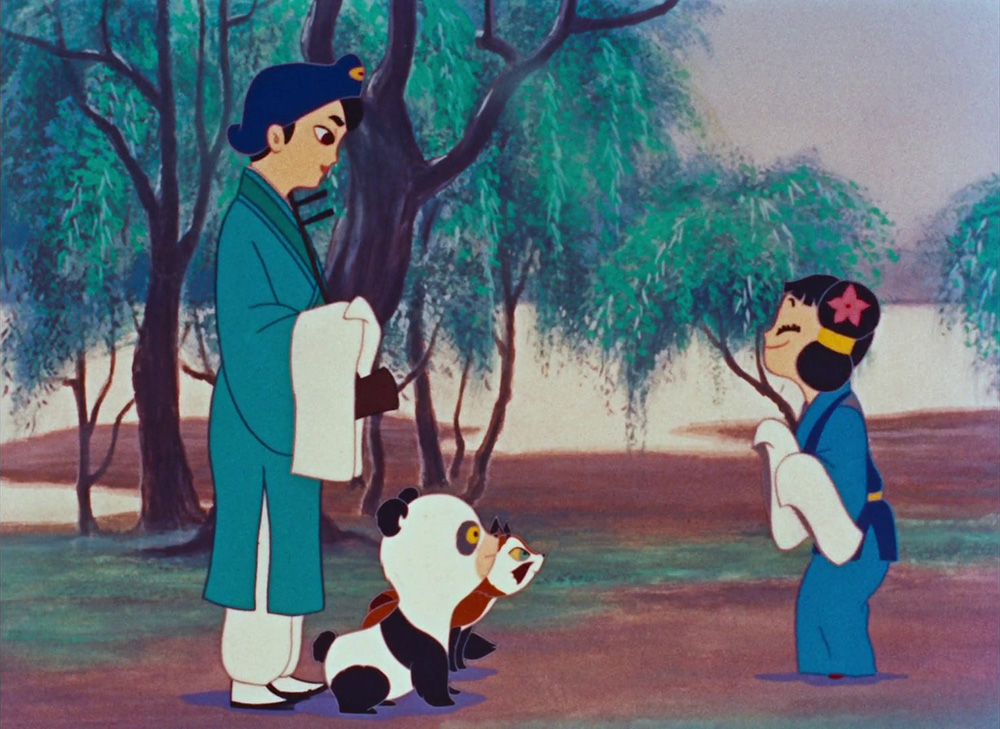
Building on TOEI’s animation studio, TOEI DOGA was founded in 1956 after TOEI acquired NICHIDO EIGA. NICHIDO EIGA was a studio that, despite changes in its name and organizational form, possessed experienced animators who had been consistently engaged in animation production since the mid-1920s. Accordingly, TOEI DOGA can be seen as having inherited the human resources of the Japanese animation industry. While animators were convinced of the commercial and artistic potential of domestically produced animation, the establishment of TOEI DOGA was also driven by the strategic intentions of TOEI president OKAWA, who recognized animation’s potential as a commodity and envisioned its export to international markets. To contend with the international market, it was essential to produce color feature-length films in the style of full animation that Disney had effectively established as the industry standard. To make this possible, TOEI DOGA rapidly developed its production infrastructure through substantial investment.7 OKAWA announced that he would turn TOEI DOGA into “the Disney of the East” and actively incorporated Disney’s production methods and techniques. In 1957, an animation studio was constructed measuring around 670 m², the largest in Japan, equipped with several large-scale machines, including multiplane camera.8 TOEI DOGA’s YABUSHITA Taiji, the director of Hakujaden (Panda and the Magic Serpent), visited several American animation studios, including Walt Disney Studios, where he investigated production equipment and facilities, including coloring paints. This translated to TOEI DOGA completing the color feature-length animated film Hakujaden (Panda and the Magic Serpent) in 1958 (Fig. 1). That a full-length color feature was produced in the short span of nine months—led by two experienced animators from NICHIDO EIGA in charge of the key animation, while supported by 42 novice animators—was a remarkable feat.9 Although the paints, cameras, and production techniques were clearly modeled on those of Disney, the creators were mindful to avoid turning the work itself into a Disney imitation. The film’s art director explained they intended to produce elements unique to the East.10 While this approach was evident in the narrative, character design, and the beautiful backgrounds inspired by East Asian ink paintings and folding screens, in its realist-oriented full animation, Hakujaden (Panda and the Magic Serpent) ultimately remained within the Disney style. TOEI DOGA went on to produce several feature-length color animated films for theatrical release in quick succession, starting with Shonen sarutobi sasuke (Magic Boy) in 1959 and Saiyuki (Alakazam the Great) in 1960. At this point, TOEI DOGA was already publicly promoting the idea that its technology and facilities were on par with those of Disney.11
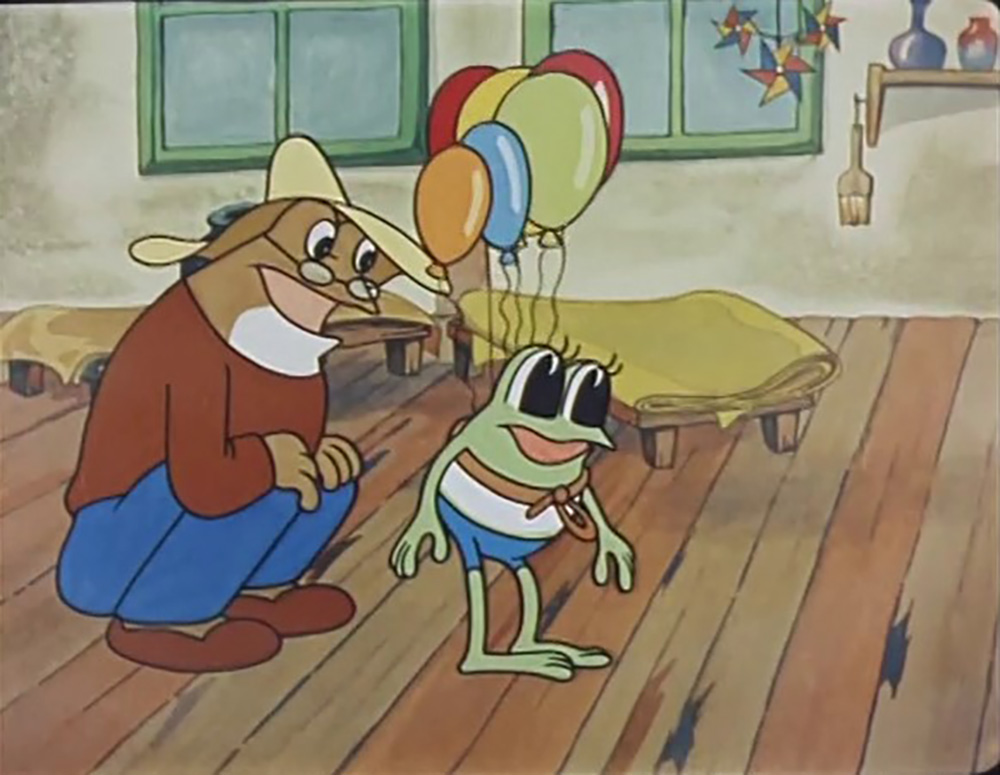
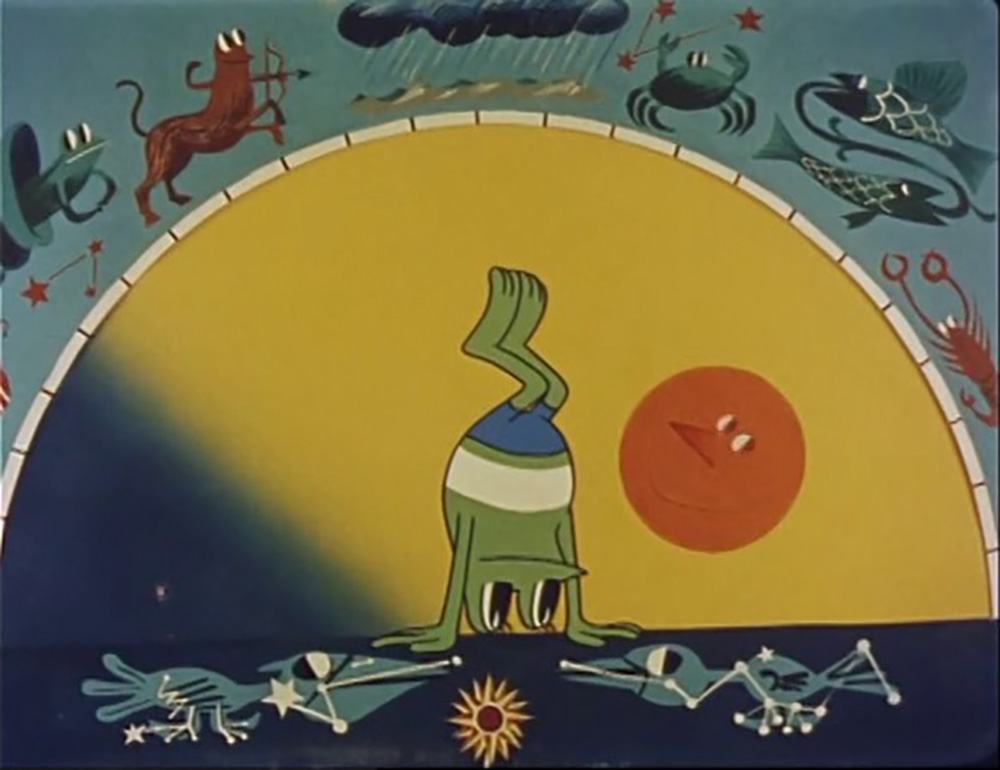
At the same time, YOKOYAMA Ryuichi, the manga artist behind Fuku-chan (1936–1971), fulfilled a lifelong ambition in 1956 by founding the animation studio Otogi Production on a portion of his home property. Much of the equipment was either repurposed second-hand machinery or devices he had constructed himself.12 YOKOYAMA, who had learned animation production techniques through self-study, together with a small number of animators who shared his passion, created the medium-length color theatrical animation Fukusuke in 1957 (Fig. 2) and, in 1959, the feature-length film Hyotan suzume (The Sparrow in the Pumpkin) with a total of only 23 staff members.13 Owing to YOKOYAMA’s own renown and network of connections, Otogi Production’s works were distributed by the major film company TOHO. Still, for Yokoyama himself, animation was far removed from any commercial objectives. YOKOYAMA was an avid film fan and film critic, and for him, Walt DISNEY was a uniquely important presence. On a business trip to the United States in 1951, he had the opportunity to meet Walt DISNEY and visit the studio.14 Magazines at the time often described him as having started animation aiming to create a “Japanese Disney,” although it is unclear whether this claim came directly from him. Based on YOKOYAMA’s essays and commentary on Disney films, he appeared to acknowledge DISNEY’s success as an animation creator while regarding him as a source of inspiration for his own creative drive, even harboring a certain sense of rivalry. In 1958, an article in a weekly magazine noted his ambition, which was to create “animation distinct from Disney Productions, characterized by original creativity.”15 Otogi Production had no organized system of specialized departments like Disney Studios, and in terms of technology, studio facilities, scale, and budget, there was an enormous gap. In repeatedly comparing his work to DISNEY’s and objectively assessing the disparities in the production stage, YOKOYAMA conveys an awareness toward DISNEY as a fellow animator on equal terms: “Nevertheless, the essential principle of manga eiga (lit. manga film) is setting each drawing in motion, and in that, DISNEY and I differ not in the slightest.” “My studio has just three animators, including me, so it is fair to say that what Disney does in one month would take us 10 months.”16 YOKOYAMA drew on his own inventive ideas, incorporating techniques like cut-out animation, stop-motion, and direct animation, and, together with his painting-like color palette, created a uniquely personal animation style. Consequently, although Otogi Production films, which combined a variety of styles, may feel technically less developed than those of TOEI DOGA, in their story, spatial direction, and color design, they departed from the Disney style.
In Japanese film magazines, articles about Disney can already be found as early as the 1930s. One example is a July 1934 article in Eiga hyoron (The Filmcrit) entitled Manga eiga to tanpen eiga kenkyu (Manga Films and Short Film Studies), which discusses Walt DISNEY and his films. In the September 1942 issue of Eiga Gijutsu (Film Technology), the facilities of the Disney Studio and its production process are introduced in detail, accompanied by photographs. At a time when manga eiga (manga film) themselves were rarely covered in film magazines, the frequency of such references indicates a high level of interest not only in the works of the Disney studio, but also in DISNEY as an individual. By the mid-1950s, the name “Disney” had become synonymous with success in the animation industry and was used in expressions such as “The Disney of Japan” to describe animators or studios. For example, in the 1958 Eiga to Engei (Film and Performing Arts) article, under the headline Nippon dizuni no honkyo (The Base of Japan’s Disney), TOEI DOGA and Otogi Production are introduced as two studios that would lead “the dawn of Japan’s manga eiga era” (Fig. 3).17 Despite their popular appeal and widespread public recognition, contemporary Disney works were met by critics with negative assessments, describing them as marked by “stylistic stagnation” and “formulaic.”18 Although many acknowledged Disney’s technical excellence and accomplishments, critics increasingly identified a sense of stagnation in its then style and, instead, focused their attention on “limited animation,” a style developed mainly by United Productions of America, viewing it as a new “anti-Disney” movement.19 IMAMURA Taihei, known for Manga eiga ron (Manga Film Theory), separated Disney’s technical accomplishments and production system from its artistic approach, and characterized the latter—grounded in naturalism—as being “at an impasse,” thus signaling “the decline of Disney.”20 NOGUCHI Hisamitsu ends his 1953 short essay on the artistic development of manga eiga with the following phrase: “One could say that the slogan of today’s progressive manga eiga creators is to ‘save manga eiga from the Disney-esque style.’”21 In a February 1956 article, film critic FUJIKAWA Harumi characterized the global animation trends as being “in a period of transformation, aiming to produce something distinctive without being swept away by Disney’s aesthetic.”22 As such, in Japan during the 1950s, Disney commanded overwhelming recognition, and its techniques were highly valued, yet its style was met with critical scrutiny.
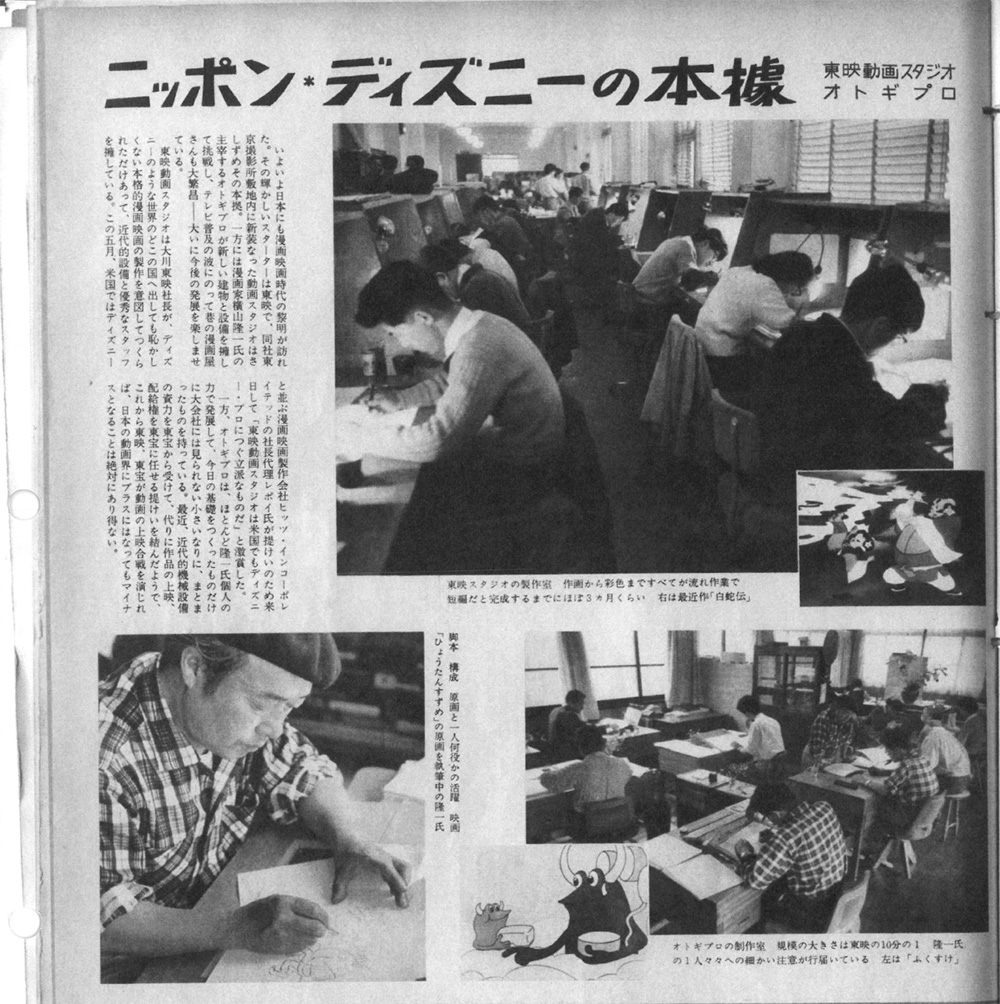
How, then, were TOEI DOGA and Otogi Production evaluated while being compared to Disney? Having openly declared its goal of becoming “the Disney of the East” and having adopted the Disney Studio’s production system as a model, TOEI DOGA was subject to comparison with Disney across many dimensions. Although its remarkable rapid growth and the quality of its productions were acknowledged,23 what was viewed critically in comparisons with Disney was not so much that it “fell short” of Disney, but rather that it “evoked Disney.”24 This suggests that, even with the advent of full-length Japanese animation films, reactions were colored not only by concerns over Disney imitation, but also by the perception that Disney’s style itself was already becoming stagnant, leading to disappointment. In his review of Hakujaden (Panda and the Magic Serpent), OKAMOTO Hiroshi noted that “the enjoyment of Japan’s unexplored manga eiga resides in the potential to explore new realms of animation without reference to Disney.”25 Furthermore, as TOEI DOGA marketed Hakujaden (Panda and the Magic Serpent) as Japan’s first feature-length color animation, there were expectations that the work would showcase Japanese traditional arts and elements of Eastern sensibilities.26 For instance, a 1960 article on Toei’s second full-length animated film, Shonen sarutobi sasuke (Magic Boy), reported the Japan Film Export Association’s comment that “by following Eastern narratives and unique Japanese techniques rather than imitating Disney, we expect the industry to develop significantly in the future.”27 In addition, concerning the studio structure, film historians NOGUCHI and SATO observed in 1961 that whereas DISNEY operated as an artist and the artistic core of his studio, TOEI DOGA relied on a collective of skilled craftsmen and lacked an equivalent artistic figure.28
On the other hand, with regard to YOKOYAMA Ryuichi, the term “Japan’s Disney” is occasionally found in magazines and newspapers,29 but when critics compared him to Disney, whose scale and equipment were on an entirely different level, it was largely a favorable evaluation of how his forms of expression differed from Disney. Critic OKAMOTO Hiroshi lauded YOKOYAMA’s originality in the pre-Fukusuke trial work Onbu obake (1972–1973), and judged, from the artistic and ideological tendencies observed in the work, that it represented a “creative opposition to Disney realism.”30 IIZAWA Tadashi, in his assessment of Fukusuke, appreciated its “skillful pictorial expression” and “artistic quality as an image,” in contrast to the “problematic realism” that Disney tended to fall into.31 This interpretation was carried forward by art critic NAKAHARA Yusuke in his discussion of YOKOYAMA’s subsequent work, Hyotan Suzume (The Sparrow in the Pumpkin), which he evaluated in a similar way.32 From a more critical perspective, the fact that YOKOYAMA Ryuichi was a well-connected cultural figure with considerable personal esteem may have created a context in which more favorable evaluations of his work were likely to emerge. Nevertheless, reviewers recognized a unique artistic approach in Otogi Production’s films, distinct from Disney, evaluating it positively.33
Animation scholar MORI Takuya has conducted an interesting comparison of the two studios, using Disney as a point of reference. In a 1958 article for Eiga hyoron (The Filmcrit), he emphasized that outstanding animated film production depends more on ideas and artistic sensibility than on technical prowess. In the article, he likened TOEI DOGA’s productions, given their scale and production methods, to those of the Disney Studio of 1937-38, yet pointed out that, unlike Disney at the time, TOEI DOGA lacked a DISNEY-like guiding figure. That period marked the Disney Studio’s technical maturity and the production of the feature-length film Snow White, yet the key point was the absence of an equivalent “DISNEY” figure at TOEI EIGA. This aligns with the earlier comments by NOGUCHI and SATO. In contrast, Otogi Production, led by YOKOYAMA, is likened to the Disney Studio of 1931–32, steadily progressing in a positive direction. This was around the time of the introduction of color film, a period of growth poised for significant technical advancement. As MORI puts it, the former follows Disney in terms of animation production style, while the latter “has grasped Disney’s spirit.” In both cases, these are MORI’s words of encouragement, yet they form an intriguing contrast.
In this article, I have attempted to interpret the developments of the “dawn” of Japan’s commercial animation industry in the 1950s by highlighting discourses by critics and animators from a perspective of “reactions to Disney.” Understanding the dynamics of history fundamentally requires multiple perspectives, and this article is only a presentation of one specific perspective. Yet it reveals the strong expectation and enthusiasm for Japanese animation that arose in the wake of confronting Disney. During the making of Fukusuke, YOKOYAMA Ryuichi remarked, “I am truly amazed by the skills of Disney Productions, yet Japan can achieve the same if it puts its mind to it. I want to lead the way as a pioneer.”34
From a historical perspective, it can be said that it was TEZUKA Osamu, who inherited YOKOYAMA’s intentions. He respected YOKOYAMA as a predecessor and manga artist who had helped cement the production of manga eiga (manga film). In 1962, TEZUKA founded the animation studio Mushi Production, using his own personal funds. A well-known admirer of Disney films, TEZUKA lauded DISNEY’s achievements but also observed that his success had caused full animation—created with enormous budgets and staff—to be widely regarded as the norm in the animation world. In TEZUKA’s view, animation should inherently be producible even with limited resources, and he explained that he founded Mushi Productions to “completely set Disney aside and seek methods to produce [animation] simply.”35 In the early days of his small studio, TEZUKA’s effort to break free from the Disney style and produce “animation without movement” can be seen as a bold yet wise approach. His exploration of artistic expression through “non-moving animation” began with his experimental film Aru machikado no monogatari (Tales of a Street Corner) (1962), while he implemented it as an efficient production strategy in Tetsuwan atomu (Astro Boy). TEZUKA Osamu’s approach to animation, developed through his confrontation with Disney, can be regarded as a pivotal turning point in his exploration of new forms of expression.
notes