© Agency for Cultural Affairs.
TSUKADA Yutaka
Photo: KURIHARA Osamu
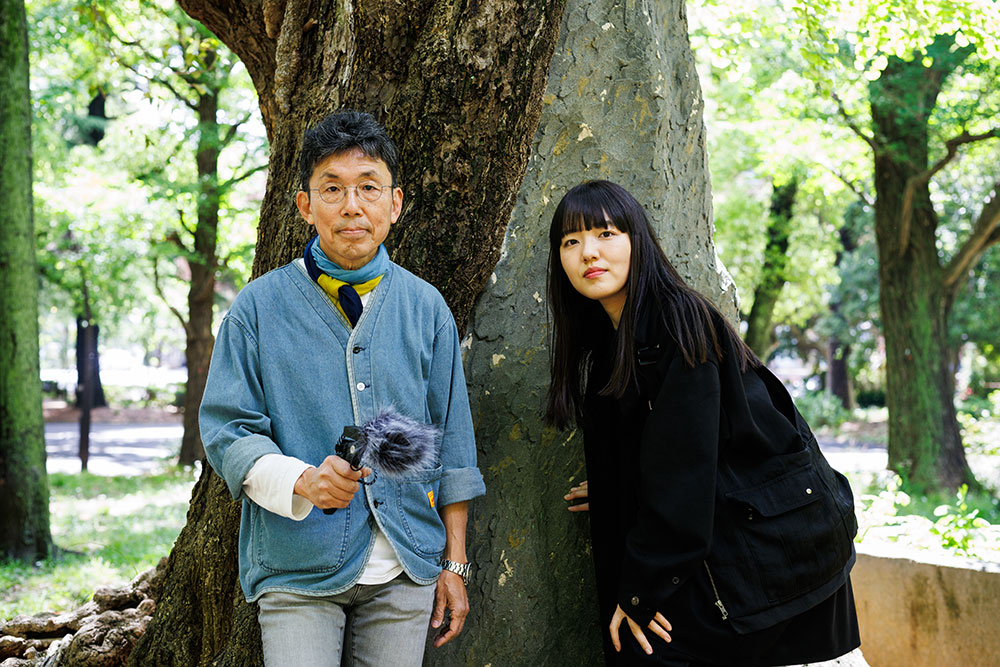
This series of conversations, led by artist and researcher KUBOTA Akihiro, explores the future of art and technology over the next century. The fifth guest is artist HOSOI Miyu. HOSOI’s work revolves around sound, creating recorded pieces and sound installations. This conversation took place following a viewing of Yohakushi (Margins of History), which was presented at Park×Art: Playground Becomes Dark Slowly held in Hibiya Park, Tokyo from Saturday, April 27, to Sunday, May 12, 2024. In Yohakushi, HOSOI invited various individuals to collect sounds in the park from their unique perspectives. These collected sounds were then played back through the park’s announcement speakers, blending seamlessly with the surrounding environmental sounds. The conversation centered on this artwork, which is intended to be publicly archived as historical material in institutions such as libraries.
KUBOTA The theme of this series is to explore how art and technology can imagine the world 100 years from now. I’ve spoken with several guests so far, but nothing seems more fitting than your work, Yohakushi (2024), for this series. Could you tell us about the background behind creating this piece and what you aimed to achieve with it?
HOSOI Art installations were to be exhibited in Hibiya Park as part of an event called the Flower and Light Movement, organized by the Tokyo Metropolitan Government. NAGAYAMA Yuko and OMAKI Shinji had already been confirmed as participants when the curator YAMAMINE Junya approached me to create a sound art installation that would connect their works.
I enjoy creating site-specific works, so I began researching the park. Through this process, I came to see Hibiya Park as a place steeped in history, yet one that continues to change. Its proximity to the Imperial Palace and government ministries also struck me as fascinating.
Parks serve several roles—they’ve been used as wartime mortuaries and as evacuation centers during natural disasters. In this sense, they function as empty spaces within the urban landscape. While these events are documented in historical records, it made me wonder if it might be possible to archive these changes by focusing on this ever-shifting nature of the space itself. That was the inspiration behind Yohakushi.
KUBOTA Artworks often lean toward being predominantly visual or physical, but sound—a medium that exists in empty space—seems to have been a perfect fit for the park this time.
HOSOI Thank you. Even I was surprised at how many variations of “sound” exist in the park. It varies with the time of day, and I noticed new ones every day during my research. The park serves as a pedestrian walkway for people working nearby during the week as well as a playground for children on weekends.
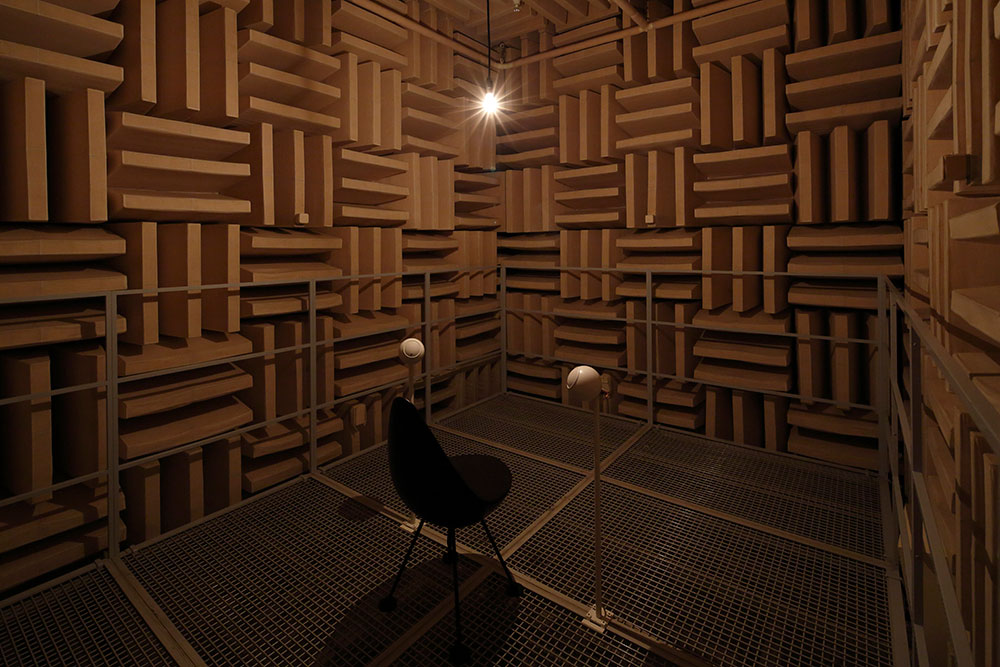
This work was also influenced by the conversation we had during my exhibition, Lenna (2019), at the NTT InterCommunication Center [ICC] as part of Open Space 2021: New Flatland. We focused mostly on technical aspects like system diagrams and formats in this conversation, but at the end, you mentioned that while the technical aspects are, of course, important, what’s even more crucial is that someone has to want to preserve that work.
That idea had a direct influence on Yohakushi. For this piece, I asked 15 of my friends, including myself, all of whom have different perspectives on the world, to record sounds in a highly subjective manner. I felt that if the recordings didn’t resonate with me personally, they would have no chance of being preserved.
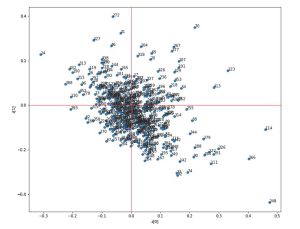
I also conducted objective recordings. Ono Sokki, a company specializing in sound measurements, was part of the team. They divided the park’s 300m×500m area into a grid and simultaneously recorded 30 people using equipment capable of capturing frequencies far beyond human hearing, ranging from 1Hz to 100kHz.
KUBOTA That’s really fascinating. What I wanted to convey during our conversation at ICC was the importance of the synergy between the desire to preserve and technology as a means to make people aware of things they wouldn’t ordinally notice. That’s why I find it so interesting that you combined subjective recordings from individual perspectives with objective, multi-point recordings that even captured sounds beyond the range of human hearing.
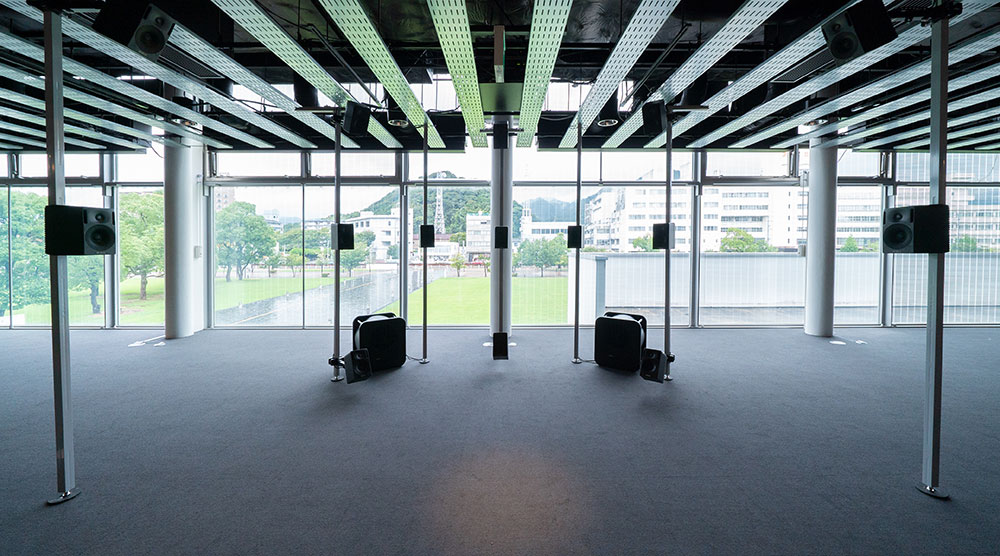
KUBOTA I heard that you used iPhones for simultaneous multi-point recording. Much like how ANNO Hideaki actively incorporated iPhones and iPads into his filmmaking, using familiar, everyday tools seems to open up new creative possibilities.
HOSOI Absolutely. I’m often surrounded by advanced technology, but that’s because I’m working in research and development settings or alongside experienced artists. When it comes to creating my own new project, however, I have to build the environment from scratch. Naturally, this slows things down, and challenges like funding and equipment often make it even harder to create something right when inspiration strikes.
That said, having worked with various types of equipment, I’ve come to understand the distinction between what can only be achieved in a high-tech environment and what should always remain a priority regardless of the tools. These days, in my lectures at university, I often tell my students that “Technology shouldn’t become the concept itself.” Technology might become outdated within a year. If the concept isn’t strong enough to withstand that evolution, preserving the work often means preserving the equipment itself, which isn’t ideal. As long as the equipment itself isn’t the objective, there’s so much potential in using an iPhone.
We could have created full-bodied sounds by using high-quality speakers for Yohakushi. However, we deliberately chose to use the public address speakers in the park. By doing so, the past sounds recorded at the park blend with the present sounds, creating a connection that feels authentic to the park itself. Using equipment already available in the park gave the work its meaning. It’s only recently that I’ve been able to make decisions like this.
KUBOTA Media Art is often referred to as art that utilizes cutting-edge technology, but that is a huge misconception. While advanced technology can occasionally discover new possibilities, the more advanced it is, the more it tends to be rooted in conservative concepts and conventional usages. Unknown potential often lies in affordable, everyday things. That’s why using casual and anonymous items like an iPhone in ways unforeseen by its creators is far more interesting.
The same applies to sound recording. With the widespread adoption of 32-bit float recording, recording sound has become much easier these days without needing to adjust levels. This is similar to how photography has become far less intimidating with the autofocus and auto exposure settings in cameras. Cost reduction and everyday use of such technology are not only transforming how we record but also reshaping our perceptions of sound spaces and even time itself.
HOSOI That’s an interesting perspective. In the case of Yohakushi, I collaborated with engineer ITO Takayuki to fine-tune the park’s speakers. At one point, we equalized the speakers and neutralized their traits, making them sound flat. However, the result felt off—it sounded like any ordinary speaker, which didn’t feel right and wasn’t quite the effect I was aiming for. In the end, we reverted to the original EQ with less bass and more treble. Working on this project made me contemplate the nature of speakers as a medium.
KUBOTA That’s a fascinating story. When I had a workshop on making custom speakers at the university, I discussed how speakers with unique quirks allow for more interesting uses than standard, off-the-shelf speakers that aim for a neutral, versatile sound reproduction that can adequately play any sort of music. If you think of speakers as a kind of instrument, you can create a sound that leverages the specific quirks of your personalized speaker. By doing so, you can go beyond and even deconstruct the conventional notion of off-the-shelf speakers, which are designed purely for accurate sound reproduction. There is still so much untapped potential in sound mediarity.
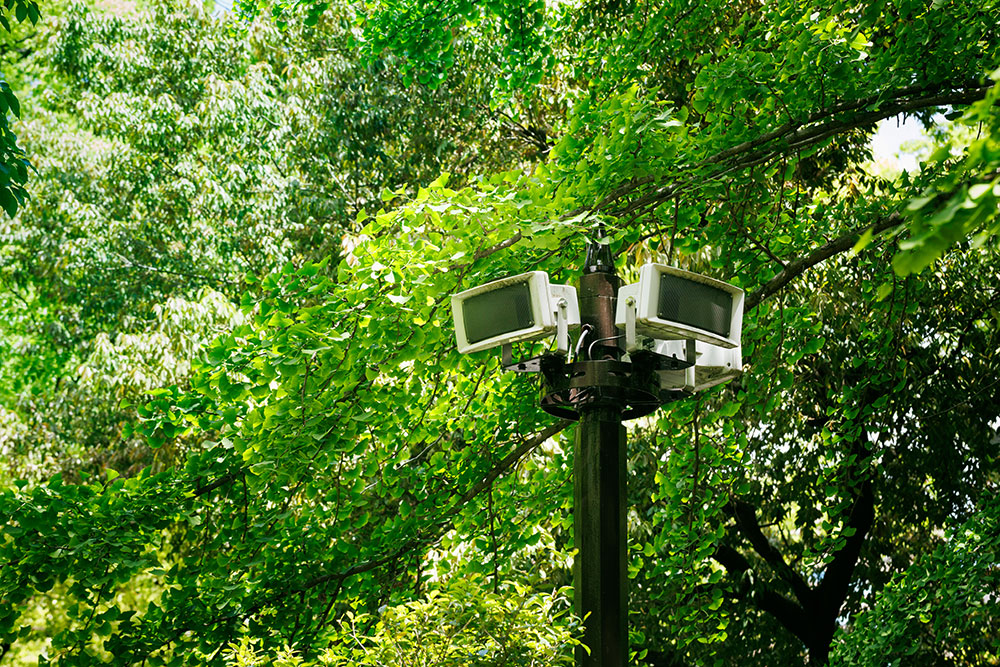
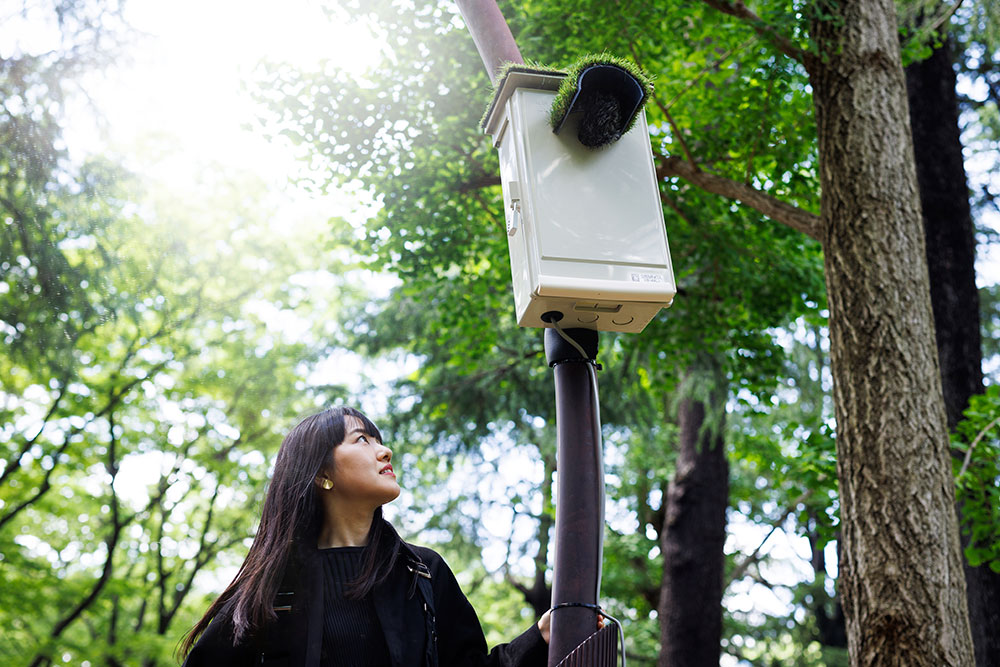
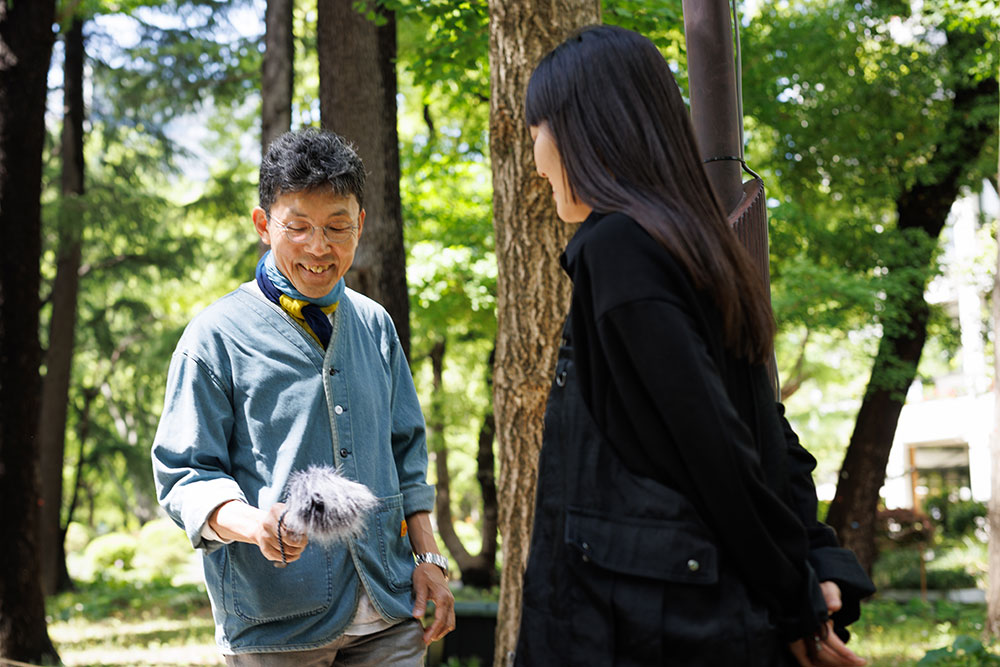
KUBOTA This morning before we met, I tried field recording HOSOI-san’s work.1 The environmental sounds of that location mixed with the sounds from the speakers created an interesting soundscape.
HOSOI Yes. I asked 15 people to record for this project, and all of them turned out interesting. I thought there might be some overlap, but everyone focused on completely different aspects. So, I think even with your recording of my work, there must be an “auditory perspective” unique to you.
And this isn’t simply about physical directionality: It’s about decisions like what scene you want to record and when you decide to start and stop the recording. That’s why I wanted to experiment with different locations for this project, and further develop it into a more systematic format.
KUBOTA I see. This might be similar to vernacular photography2 in photographic theory. It could open up a new discussion on local and colloquial sounds as well.
HOSOI There are various ways to archive things like photographs, videos, and measurement data, but with sound, just three seconds can convey an immense amount of information. Looking at a photograph for three seconds might not be enough to grasp the context of the photo, but sound is closer to a phenomenon—it carries a bodily, tangible truth. I am convinced of this and would like to convey it in a language that can be shared amongst everyone, but then, I wonder if that might diminish its unique qualities.
KUBOTA Once a common language is established, it could quickly turn into a power game. Do you mean that you’d like to take it slow and put careful consideration, like an accent or dialect?
HOSOI That’s right. I still want to have fun with it (laughs).
HOSOI I love the Voyager Golden Record.3 I feel like it represents the idea of understanding ourselves through archives, and I enjoy reflecting on which aspects of my work I want to preserve. Yohakushi was also inspired by the Golden Record, with a similar mindset of believing in something and trying it out. The recordings are planned to be archived at a public facility in Tokyo.
I don’t think simply submitting audio files continues true preservation as an archive. So, I am planning to create a booklet that reflects how libraries and museums store collections. It would include information like the biographies of the people who made the recordings, as well as the recording dates and locations. Curator YAMAMINE and SUDO Nanami, a member of their curatorial team, have been a great help in this area with their expertise in digital archives.
KUBOTA It’s too late to wonder now what the sounds of Hibiya Park were like during the war when it was used as a temporary morgue. It’s not just about the sound recording itself, however, you’d also want to record who wanted to preserve them and why.
HOSOI Exactly. Regarding Hibiya Park, I actually contacted the Tokyo government to see if any past visual materials contained sound, but they were all overdubbed with classical music. However, advancements in sound analysis have been remarkable. ISHIDA Koji from Sound One, who participated in the multi-point recording and IR recordings at the Hibiya Public Hall, and who is also the chairman of the Institute of Noise Control Engineering of Japan, mentioned that it was recently revealed that we can now assess the health conditions of forests, flora, and fauna, through the accumulation of inaudible sound data.
So in the future, say 100 years from now, analysis will likely be even more advanced, and Yohakushi could serve as a reference for a recording of the park’s ecosystem. I think it’s incredible to record sounds for such purposes.
KUBOTA One of the roles of science and technology is to transcend the everyday imagination of humans. The Voyager Golden Record is fascinating because it was conceived with the idea that it would be read by extraterrestrial life or intelligence. Since there is no definitive answer, if we were to once again create the Golden Record today, what would it look like? It would inevitably reflect the social and political climate of the time, as well as our views on humanity. Achieving something truly objective and neutral would be impossible.
HOSOI This would be an interesting assignment for university students. Speaking of which, it reminds me of a recording we made where a group of elementary school kids were talking endlessly about missiles. They probably heard about them on the news, but it broke my heart.
KUBOTA It might not have felt out of place at the moment, but when you listen to it again in a different context or situation, it often brings out new emotions and meanings. This is where the significance of recording and re-listening comes into play. The focus varies depending on the listener, and archives have the potential to reveal these different perspectives. They aren’t necessarily confined to the creator’s original intentions. Even in 10 years, let alone a century, re-listening to sounds recorded today would undoubtedly be fascinating.
The desire to preserve and what lies beyond
KUBOTA Much like sound, interactions are also challenging to preserve, but the late MIKAMI Haruko always emphasized that interaction was at the core of her work. I’m currently watching and analyzing interactions by examining the archive of the viewer’s gaze data of her Eye-Tracking Informatics.4
HOSOI I really love MIKAMI-san’s work too. Lately, however, the term “interactive” has been broadly used that it feels as though it’s been absorbed into a wider context, straying from the initial perspective that I really appreciated. It’s disheartening to see the meaning of the word “interactive” constantly change.
KUBOTA This phenomenon applies to all words. Their meanings and usages constantly change over time. For instance, the design of computer GUIs (Graphical User Interface), and what is now called UX (User Experience) are indeed forms of interaction, but this wasn’t the perspective people had at the time of their inception. Moreover, audiences or those who experience are not the same as users. That’s why it is crucial to preserve archives as much as possible, to allow us to continue and deepen discussions. Reflecting on today’s conversation with you, I’ve started revisiting the question: “When does the motivation to preserve sound arise?”
With smartphones equipped with cameras, many people now spontaneously take photos. In the past, people would decide to capture a moment to preserve it, but now it tends to be more subconscious or reflexive, with decisions on how to use the photos afterward. However, sound, despite being recordable through smartphones, has not yet reached the same level of integration. This makes me curious about how non-visual sensory cues and perceptions will be recognized, recorded, and reproduced in society as technology evolves.
HOSOI I believe that you can’t judge someone’s “desire to preserve” as better or worse. Even if the photo contains someone I don’t know, if the owner of the photo says that they really wanted to preserve it, I can’t help but think deeply about their attachment to it.
KUBOTA That makes perfect sense. That’s why I hope you continue exploring the origins of this motivation to preserve through sound.
HOSOI Yes, that’s my challenge for the time being. But who knows? In 10 years, I might end up saying, “We don’t really need to preserve anything” (laughs).
notes
HOSOI Miyu
A sound artist born in 1993. She creates works featuring sound installations using multi-channel sound systems, outdoor installations, and stage works, focusing on the way sound transforms spatial perception and situations. Her works have been presented at venues including Nagano Prefectural Art Museum, NTT InterCommunication Center [ICC], Yamaguchi Center for Arts and Media [YCAM], Aichi Prefectural Art Theater, International Commission for Acoustics (ICA), Tokyo International Haneda Airport, and more.
https://miyuhosoi.com/en/
KUBOTA Akihiro
Professor at the Department of Information Design, Faculty of Art and Design, Tama Art University, and Director of the International Exchange Center. Artist. Born in 1960. Ph.D. in Engineering from the University of Tokyo, specializing in Naval Architecture. After researching computational fluid dynamics and artificial systems, KUBOTA began teaching at Tama Art University in 1998. In 2015, he and his team received the Hybrid Art Award of Prix Ars Electronica for the ARTSAT1: INVADER. He also received the 66th Minister of Education Award for Fine Arts (Media Arts Division) for the achievement of this project. His publications include Harukanaru tasha no tame no dezain Kubota Akihiro no shisaku to jisso (Akihiro Kubota’s Thoughts on Design for Distant Others) (BNN, Inc., 2017) and Media ato genron (Principles of Media Art) (Film Art, Inc., 2018 [Co-Editor]).
information
Park×Art: Playground Becomes Dark Slowly
Date: Saturday, April 27–Sunday, May 12, 2024 9:00 AM to 10:00 PM
Venue: Hibiya Park
Artists: OMAKI Shinji, NAGAYAMA Yuko, HOSOI Miyu
https://www.tokyo-park.or.jp/special/2024art_hibiyapark/ (in Japanese)
*Conversation date: May 2, 2024
*URL links were confirmed on August 28, 2024.